
Overview
Seattle’s Housing Levy is a voter-approved property tax that funds affordable housing construction, preservation, and assistance for low-income residents. First adopted in 1981, the levy has been renewed six times and is now a central pillar of the City’s housing strategy.
The most recently completed cycle — the 2016–2023 Housing Levy — authorized $290 million over seven years to finance rental housing, homeownership programs, and homelessness prevention. This analysis examines how that levy performed relative to its original goals, based on the Seattle Office of Housing’s Annual Investment Reports (2020–2023) and the 2016 Housing Levy Administrative & Financial Plan.
A Brief History of the Housing Levy
Since 1981, Seattle voters have approved a local property-tax levy roughly every seven years. Each renewal has expanded in size and scope to respond to rising housing costs and population growth.
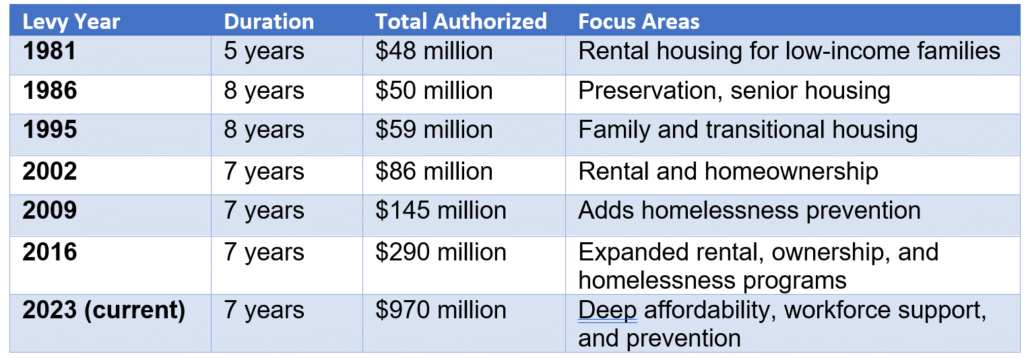
(Sources: Seattle Office of Housing, City Budget Office)
2016 Housing Levy Background
The 2016 levy, approved by 70% of voters, raised property taxes at $0.33 per $1,000 of assessed value — about $122 per year for a median-valued home in 2017. It was designed to raise $290 million over seven years, distributed across six programs:
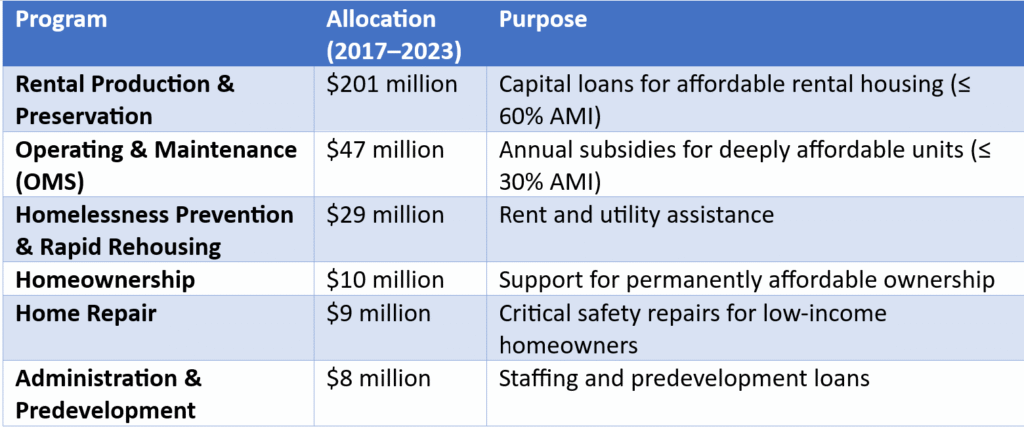
(Source: Seattle Office of Housing)
Expenditures and Leverage
From 2017–2023, the City expended the full $290 million authorization.
- Average annual spending: about $40 million.
- Leverage ratio: every $1 in levy funding attracted roughly $3 from federal, state, and private partners.
- Total public/private investment leveraged: ≈ $1.1 billion.
This leverage is consistent with the City’s prior levy performance.
Goals vs. Outcomes
The 2016 levy set numerical targets in its Administrative & Financial Plan.
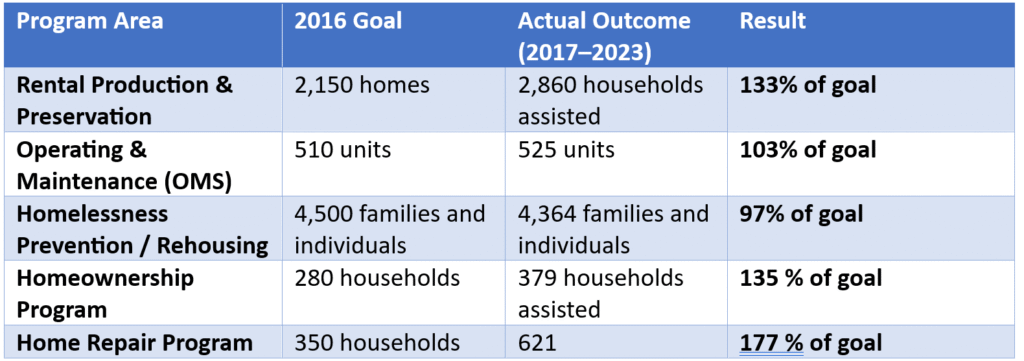
(Source: Seattle Office of Housing)
Measurable Impacts
Rental Housing
Roughly 3,600 affordable rental homes were created or preserved through the levy.
About half serve households earning ≤ 30% of area median income (AMI), including permanent supportive housing for formerly homeless residents.
Average city contribution per unit: $55,000–$65,000, or about 18 % of total project cost.
Homeownership and Repairs
The levy supported 270 permanently affordable for-sale homes and funded ≈ 500 home repairs for low-income homeowners.
Homelessness Prevention
Approximately 4,500 households received short-term rental or utility assistance, meeting the program’s target but not reducing citywide homelessness rates, which continued to rise.
Analytical Assessment
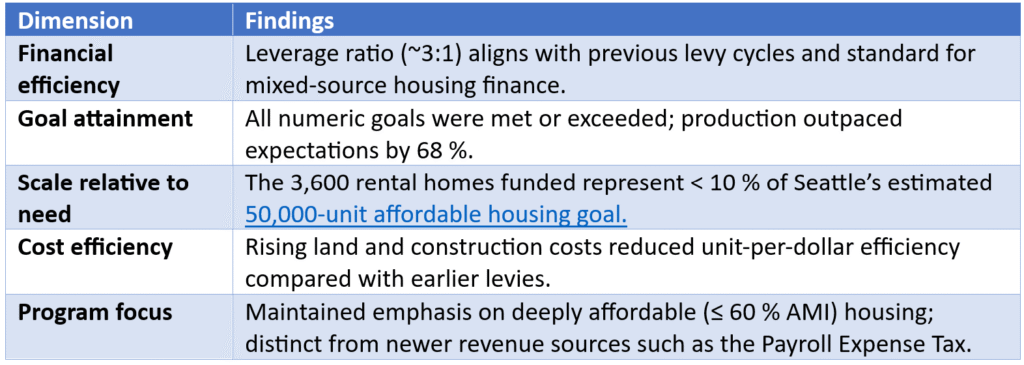
(Source: Seattle Office of Housing)
Conclusion for the 2016-2023 Housing Levy
Measured against its own stated objectives, the 2016–2023 Housing Levy was effective. It met or exceeded all production, subsidy, and prevention goals, leveraged significant external funding, and maintained program integrity across multiple housing types.
However, the levy’s scale — roughly $40 million per year — remains small relative to Seattle’s broader housing affordability gap. In absolute terms, it produced thousands of units; in systemic terms, it mitigated but did not reverse cost pressures driven by land scarcity and population growth.
The evidence suggests that the Housing Levy is a high-performing but limited tool: it delivers on what voters fund, but cannot on its own close the affordability deficit facing the city.
Seattle’s New $970 Million Housing Levy: What’s Different This Time and How We’ll Know If It’s Working
Seattle’s 2023–2030 Housing Levy is the biggest affordable-housing measure the city has ever passed. At $970 million over seven years, it’s more than triple the size of the last levy. With that scale comes a simple question: What exactly changes with this levy — and how will we know if City leaders are delivering on what voters approved?
Below is a breakdown of what’s new and how to track the levy’s performance using publicly available data. All information comes from the city’s 2024–2026 Administrative & Financial Plan and the Seattle Office of Housing’s 2024 Annual Investments & Levy Report.
The new levy is dramatically larger
The 2016–2023 levy totaled $290 million. The new one: $970.3 million.
That means the city now collects roughly $138.6 million per year, compared to around $40 million per year before.
Why the jump?
Construction costs are far higher than a decade ago. The City wants more units serving extremely low-income residents (≤30% AMI). Supportive-housing providers have been struggling financially, prompting a deliberate shift toward funding ongoing operations, not just construction.
This levy isn’t simply bigger — it is structurally different.
A sharper focus on the lowest-income households
Past levies funded housing across a range of income levels. The new levy is intentionally weighted toward units affordable to residents earning ≤30% of area median income — people who are most at risk of homelessness.
According to the Administrative and Financial Plan, this means more permanent supportive housing, more housing for people exiting homelessness, and larger units for low-income families
This shift in income targeting is one of the most consequential policy changes in the levy’s design.
Most levy dollars now flow into rental housing construction
More than $700 million — about 73% of the whole levy — is dedicated to building and preserving rental housing.
The city has already begun at this pace. In 2024, the Office of Housing committed: $108.2 million for seven rental projects totaling 655 new homes (867 bedrooms). If this production level continues, Seattle will hit — or even exceed — the levy’s multi-year targets.
A major philosophical shift: funding operations, not just buildings
The single biggest policy evolution in the new levy isn’t the size — it’s the city’s willingness to fund ongoing operations, including workforce stabilization for supportive-housing staff.
The “Operating, Maintenance & Services” (OMS) program jumps from $47 million in the old levy to $122.3 million now.
What does that mean in practical terms? More money to ensure deeply affordable buildings remain solvent. More funds to reduce staff turnover at supportive-housing facilities. Better ability to serve people with very low incomes or complex needs
Seattle is acknowledging — in a way it hasn’t before — that building units is not enough if those units can’t be sustainably operated.
Homeownership remains part of the picture, but a smaller part
The levy dedicates $50.7 million to affordable homeownership development and down-payment loans.
This includes permanently affordable, resale-restricted homes and shared-equity models through community land trusts
These programs tend to produce dozens of homes per year — not hundreds — but they create long-term affordability at the individual household level.
What the levy promises to deliver
Over seven years, the levy aims to produce or support:
- 3,960 rental homes
- 475 affordable homeownership units
- Operating support for ~5,000 deeply affordable units
- Housing stability assistance for ~4,500 households
These are multi-year targets, not guaranteed outputs each year — meaning success will be measured over the full 2024–2030 cycle.
How to tell whether the levy is actually working
If you want to judge the effectiveness of this levy without political spin, here are the five metrics that matter. All of them are available in the city’s annual levy reports.
First, are we producing the promised number of homes?
Track year-by-year commitments and completions using the Annual Investments & Levy Reports. The target is 3,960 rental homes over seven years.
Pay attention to: how many units are funded each year, how many eventually complete construction, and the income levels they serve.
Second, are per-unit costs rising faster than expected?
Seattle publishes City dollars per unit and total development cost per unit for each project in the Office of Housing annual investment report. Rising costs may reflect construction inflation — but they may also hint at inefficiencies or project-type shifts.
Third, is Seattle still leveraging outside money effectively?
Historically, levies attract around $3 of non-City funds for every $1 of levy money.
Annual reports show exactly how much federal, state, and private capital is leveraged each year. A drop in leverage would suggest the levy is bearing more financial weight than before.
Fourth, are supportive-housing operators becoming more stable?
Since the levy now invests heavily in OMS and workforce stabilization, to reveal whether the levy’s operational support strategy is working, track indicators like staff turnover, service interruptions, building-level operating deficits, and the number of OMS-supported units.
Fifth, where is the housing being built, and who gets to live there?
Annual reports list project addresses, unit sizes, income restrictions, and targeted populations. This reveals whether the levy is meeting the city’s goals around equity, family housing, supportive housing, and neighborhood distribution.
The bottom line
Seattle’s new housing levy represents a serious shift: more money, deeper affordability, and a stronger emphasis on keeping existing housing stable. Whether this $970 million investment works will depend on sustained production, cost control, continued leverage of other funding sources, and measurable improvements in the financial health of supportive housing.
The good news is that Seattle publishes all the necessary data. Anyone – residents, journalists, policymakers – can evaluate the levy’s performance as it unfolds.
Keep in mind, however: the Housing Levy is only one piece of Seattle’s broader approach to affordability. Other major tools — zoning, permitting, transit-oriented growth, the Mandatory Housing Affordability program, and the business Payroll Expense Tax — shape the overall supply of affordable homes in ways that are harder to measure.
The levy performs well against the goals set for it, but it operates inside a larger housing system that remains strained. Tracking levy results is straightforward; evaluating Seattle’s entire housing strategy is far more complex, and the evidence there is decidedly mixed.
We’ll take up this bigger picture in future posts.