
… and Does That Impact Crime Rates?
When Seattle residents have been asked what issues they are “most frustrated or concerned about” over the last four years, they have consistently rated public safety in their Top 3 (along with homelessness and affordability). A 2023 survey by EMC Research found that Seattleites’ top public safety concerns were homelessness (52%), crime (23%), drugs, and theft/property crime/shoplifting (14%).
Despite voter concerns about public safety, police numbers in Seattle are down significantly over the last six years, from over 1,400 in 2019, to approximately 1,100 in 2025. A report by the Mayor’s Office in 2022 noted that because of the limited police staffing, the Seattle Police Department often didn’t respond to 911 calls at all, unless they involved “life-threatening emergencies” or “serious crimes in progress.” Seattle voters have expressed frustration with the lack of police: according to the 2023 EMC study, 70% of Seattle voters agreed that “Seattle needs more police officers.”
How did Seattle get to this point? During the pandemic (roughly 2020-2022), and as a response to the George Floyd Murder in May 2020, elected officials in Seattle hotly debated the idea of defunding the police. The concept had different meanings, but the result was ultimately that Seattle reduced its police force – through a combination of funding cuts, drops in recruitment, and by not replacing every officer who left the force.
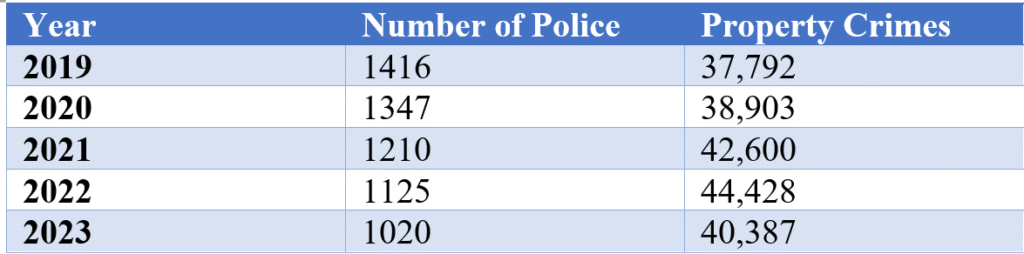
As a result, the number of police steadily went down. In 2019, according to FBI data, there were approximately 1,416 police officers. That number went down to 1347 in 2020, 1210 in 2021, 1125 in 2022, and 1020 in 2023 (the last year for which FBI data is available). According to data from the City of Seattle, the decline in the number of police officers has started to level off. The Mayor’s office reported 1054 officers in 2024, and 1123 in 2025.
So, what did the decline in police officers mean for crime in Seattle? One way to assess that is by looking at property crimes. First, a definition. The FBI’s Uniform Crime Reporting (UCR) system (and its modern successor, NIBRS), define property crimes as the following:
- Burglary or Breaking and Entering
- Larceny-Theft (includes shoplifting, pocket picking, bicycle theft, or theft from vehicles)
- Motor Vehicle Theft
- Arson
Under the FBI definition, property crimes do not include robbery (which involves force or threat of force), identity theft, or vandalism. These all fall under other categories.
In Seattle, there has generally been an inverse relationship between the number of police and property crimes. In other words, as the number of police went down, the number property crimes generally went up. In 2019, according to FBI statistics, there were 37,792 reported property crimes in Seattle, and that number went steadily up through 2023, to 44,428. However, despite police numbers going down in 2023, property crimes fell to 40,387.
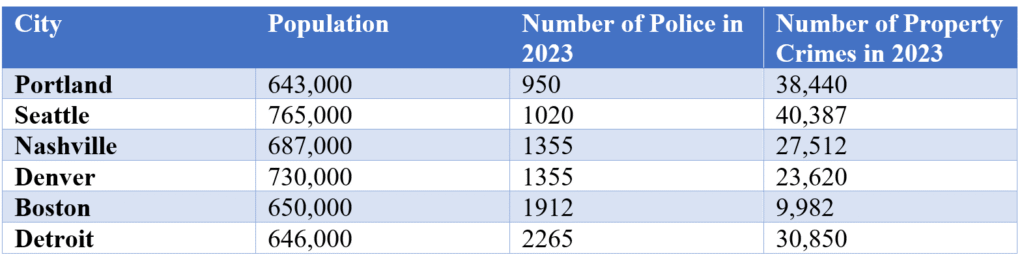
While it is interesting to look at Seattle in one year versus Seattle in another year, it is perhaps more interesting to look at Seattle versus other similar sized cities. Seattle, Portland, Denver, Boston, Nashville, and Detroit all have populations between 640,000 to 760,000. Looking at 2023 (the last year for which there is FBI data), these cities have taken dramatically different approaches to police hiring. Portland and Seattle have relatively few police (~1000); Boston and Detroit have relatively large police departments (~2000); while Nashville and Denver are in the middle (~1400). [cite]
Of course, each city has unique issues. Nonetheless, as the table below demonstrates, while there is not a direct 1:1 relationship to the number of police and property crimes, Seattle and Portland, the two cities with the fewest police, have significantly more crime than other similar sized cities. Boston, with over 1900 police officers, had one-fourth the number of property crimes as Seattle and Portland. Denver, with 1460 officers, had over 40% less crime.
Seattle Mayor Bruce Harrell has on several occasions announced efforts to “restore Seattle Police Department staffing,” including through new recruiting and retention efforts. He has indicated a desire to rebuild Seattle’s police force to 1,450 officers.
On the other hand, mayoral candidate Katie Wilson, when asked about police hiring, responded: “As mayor, I will continue hiring officers; but recognizing ongoing hiring challenges and budget constraints, I’ll also aggressively pursue other strategies to increase retention, improve responsiveness, and ensure best use of SPD’s capacity.”