
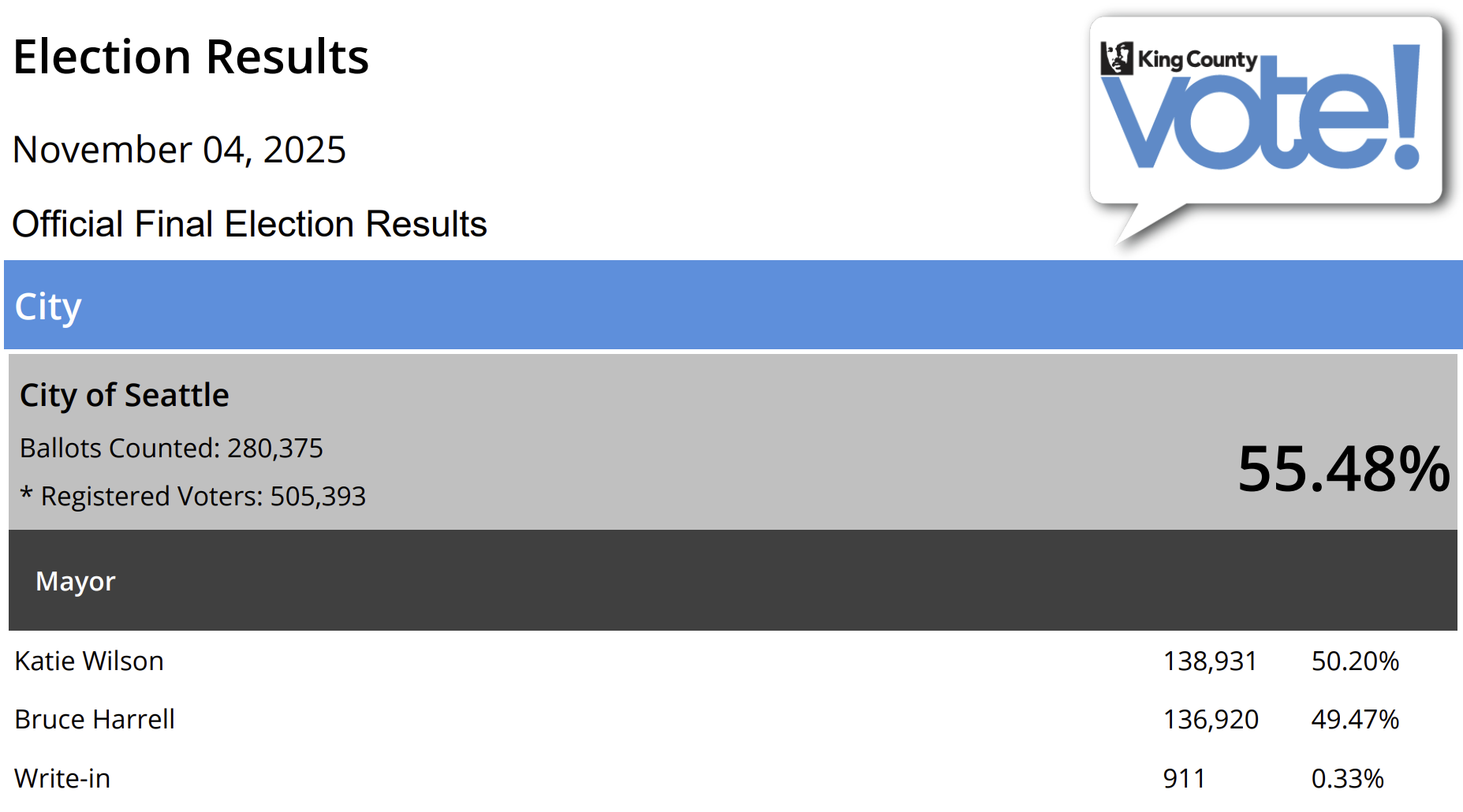
Katie Wilson is now the mayor-elect of Seattle, and there is genuine excitement for what that means, not just among progressives but among the city at large. It’s no great secret that Seattleites want leaders who reflect our values, equity and inclusion, public investment, and a belief that government should play an active role in tackling big problems.
Wilson’s victory was historic, winning by a final margin of approximately 0.73%, the closest mayoral race in Seattle since 1906. But she ran on a platform that reflected the city’s identity and our desire for urgent attention to affordability, and it feels great to see a fresh face with fresh ideas take the helm.
It’s also reasonable to carry a certain amount of caution. Those of us who have been through a few mayoral cycles know that winning an election and governing a complex city are two different things (it’s why Seattle hasn’t reelected a mayor since Greg Nickels). Progressives are often frustrated at how Seattle’s progressive identity does not always translate into smooth governance.
Here’s hoping Wilson – along with election of progressives Dionne Forster and Eddie Lin – the City Council can push forward big ideas without repeating past stumbles. We’ll be keeping our eye on what her administration will mean for day-to-day issues like Seattle’s economic growth, business climate, and public safety, areas where expectations remain high and patience has grown a bit thin.
More affordable housing while getting the balance right
Housing is the biggest issue facing Seattle. Wilson has spent years working in the policy trenches on affordability, tenant protections, and transit-oriented housing. It’s incredibly reassuring to have an incoming mayor who understands the stakes and the details. Will Wilson’s administration tackle affordability without unintentionally creating new bottlenecks in supply or other constraints that make our housing shortage worse? Can push aggressively for affordability while still keeping overall housing production moving?
How will she address the crisis in Seattle’s affordable housing sector, where some subsidized rents are actually higher than their market-rate counterparts? (The Seattle Median will be writing about this topic in a forthcoming post.) We won’t get affordability right if we can’t get the housing math right. Period.
We care about jobs and the “Community Wealth” that sustains them
It is not mutually exclusive to be a progressive and to recognize that Seattle’s economic engine is the lifeblood of our public services. Wilson’s election signals a shift in how we define economic health. For too long, “growth” in Seattle has meant aggregate numbers that mask a hollowed-out middle class and a vanishing small business tier.
We are watching to see how Wilson implements her vision for Community Wealth Building. This isn’t just about attracting the next tech giant; it’s about creating a “democratic economy” through:
- Neighborhood Revitalization: Wilson has championed the “corner store” model—legalizing small-scale commercial use (cafes, markets, and professional services) in residential zones. We’re watching to see if her administration can cut the red tape at SDCI to make these “hyper-local” jobs a reality.
- Small Business Resilience: Beyond rhetoric, we need to see the Storefront Repair Fund expanded and the implementation of her proposed Master-Lease program, where the city helps secure affordable commercial space for local entrepreneurs who are currently being priced out by institutional landlords.
- The “JumpStart” Balance: Wilson has been clear about “turning the dials” on the JumpStart payroll tax to fund social housing and green jobs. But she has also acknowledged the risk of “job-shifting” to the Eastside. We are looking for a sophisticated “diplomacy” with our largest employers—one that holds them accountable to their tax obligations while ensuring Seattle remains the primary hub for their high-wage talent.
We want a city that works for workers, but we also need a city where the “endless hustle” isn’t the only way to survive. The metric for success here isn’t just the unemployment rate; it’s the retention of BIPOC-owned businesses and the growth of living-wage jobs that actually allow people to live in the city where they work.
We want public safety to feel real, not theoretical
This is maybe where many of us feel the most cautious. We’ve had years of debate about policing, response times, drug use, and visible disorder. Most of us support reform. Most of us want a more compassionate and effective system. But we also want to feel safe in our neighborhoods , on transit, downtown, and in the places we go every day.
Wilson has talked about expanding non-police responses, and we want to see her lean into the CARE (Community Assisted Response and Engagement) department. We’re watching to see if she can scale these dual-response models so they aren’t just pilot programs but the new standard for 911 calls involving mental health or homelessness.
At the same time, we need measurable improvements: faster response times for high-priority crimes and a clear, humane approach to public drug use that prioritizes treatment without surrendering public spaces to disorder.
We’re also watching to see if she keeps Shon Barnes as Seattle Police Chief, or goes in a different direction.
Moving beyond “Paint and Plastic” on Transit
As the co-founder of the Transit Riders Union, Wilson is uniquely positioned to lead on transportation. On paper, she is perfectly aligned with Seattle’s goals for better transit and safer streets. But “aligned” isn’t enough anymore; we need a mayor who can navigate the bureaucracy of SDOT and King County Metro.
We are watching to see how she handles the massive 2024 Transportation Levy (the successor to Move Seattle). We want to see her move beyond “paint and plastic” solutions—like quick-build bike lanes—and invest in the permanent, concrete infrastructure that truly makes walking and rolling safe. We also need a mayor who will play hardball at the Sound Transit board to ensure the ST3 light rail expansion doesn’t get bogged down in further delays or cost overruns. Wilson knows the system better than anyone; now she has to prove she can make it run on time.
We’re hopeful
Katie Wilson’s election fits Seattle’s identity. We wanted someone who reflects our values and our aspirations, and we got that. We want this administration to succeed, not just symbolically, but tangibly. The Seattle Median is glad she won and we’re hoping she can be a mayor who can deliver on housing, strengthen the economy, and make our public spaces feel safer.
We’re rooting for her, and we’re ready for results.