

Why the “Social” in Social Housing is Seattle’s Biggest Policy Experiment
As the Seattle Social Housing Developer (SSHD) begins reviewing property bids, the most heated debate continues to be not whether to build, but who gets to move in. The SSHD model is mixed-income (0%–120% AMI), representing a significant departure from traditional low-income housing models that typically cap eligibility at 60% or 80% AMI.
The Pro-Social Argument: The Public Utility
Advocates like House Our Neighbors! argue that for a building to be a true community, it needs a mix of residents. They view housing not as a charity, but as a public utility—similar to how Seattle City Light provides electricity to everyone regardless of income.
- The Cross-Subsidy: Under this model, a software developer or teacher at 100% AMI pays a higher—though still capped—rent that directly subsidizes the unit of a neighbor at 20% AMI.
- Sustainability: By including middle-income renters, these buildings become self-funding. This reduces reliance on federal hand-outs and protects the agency from the “voucher cliffs” anticipated in late 2026.
The Deep Poverty Counter-Point
Traditional non-profits and some city council members are sounding the alarm. They point to the thousands currently unhoused in Seattle as the priority that should supersede all others. Critics, including those who supported alternative ballot measures, argue that social housing shouldn’t be a subsidized perk for the middle class while the most vulnerable are still waiting for a bed. The criticism is rooted in resource allocation: every dollar spent housing someone at 120% AMI (roughly $130,000/year) is viewed by some as a dollar taken away from those living in tents or cars.
The Anchor of the CID
In the Chinatown-International District (CID), groups like Puget Sound Sage are leveraging this mixed-income debate as an anti-displacement tool. They are prioritizing social housing acquisitions to secure existing “naturally occurring” affordable buildings before they are flipped into luxury condos. By bringing these into public ownership, they aim to stabilize the neighborhood for both low- and middle-income residents.
Rent Comparison: The Cross-Subsidy in Practice
To understand the friction, one must look at the math. Below is a comparison of what residents would pay for a 1-bedroom unit under the Social Housing model, where rent is strictly capped at 30% of gross income.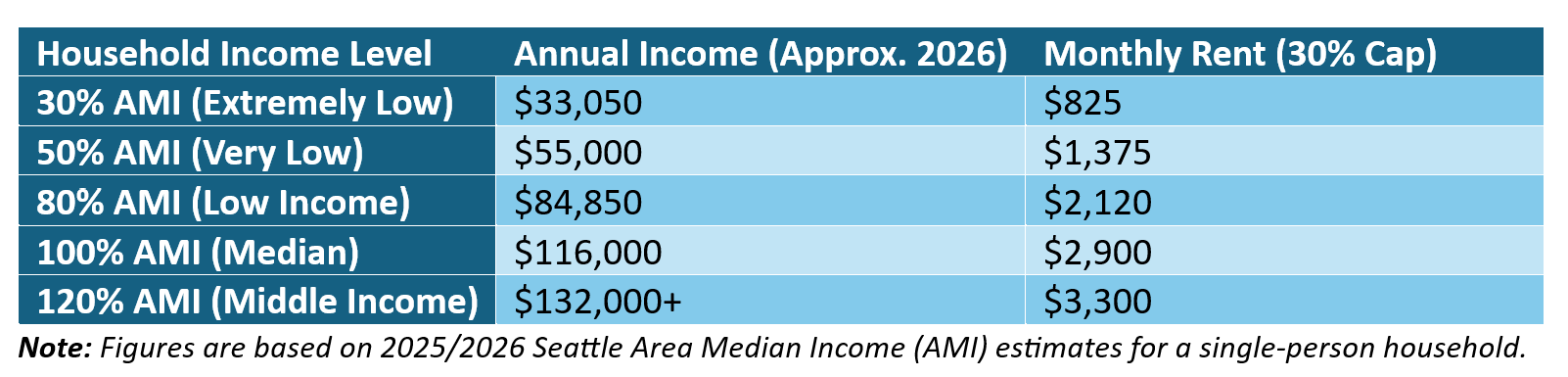
Next in this series: We’ll look at Mayor Wilson’s $1 Billion Union-Built Bond and the specific properties at the center of the 2026 construction boom.