
In writing the 2025 budget, the City conducted an analysis of each department’s budget over the past five years, charting the growth of each policy area between 2019 and 2024.
Overall, it found that the operating budget has grown $1.7 billion between 2019 and 2024, a 29% increase.
By policy area, the City’s analysis found:
- Livable & Inclusive Communities increased by 174%
- Education and Human Services increased by 65%
- Administration increased by 33%
- Arts, Culture & Recreation increased by 28%
- Utilities, Transportation & Environment increased by 17%
- Public Safety increased by 16%
We can use Open Budget to understand why Livable & Inclusive Communities increased by 174%. Check out how in this explainer:
Across all 6 policy areas, however, the City’s five-year budget analysis attributes the $1.7 billion growth in the operating budget primarily to “baseline and technical adjustments responding to historically high inflation rates.”
Specifically, “increases in personnel costs including wages, healthcare, and industrial insurance (workers’ compensation), internal service costs (e.g., IT support, facilities, and fleet services).”
In other words, a good portion of the increases do not enhance services (with the exception of the multifamily housing program detailed above). We’re paying more money for roughly the same programs and people. How much more? $638.3 million more between now and 2028.
As the Mayor’s Office notes: “In 2023 and 2024, the City ratified labor agreements with the Coalition of City Unions, the Seattle Police Officers Guild, and other labor partners. A large share of the City’s General Fund budget is spent on labor (about 53% percent). These labor agreements therefore increased the City’s cost of doing business.”
This is especially true in the General Fund – and, with unsustainable ongoing growth, is especially problematic. We explain why:
Over the past two budget cycles, budget writers have reported on what they call a “structural deficit” in the General Fund. This is another way of saying that ongoing spending regularly exceeds incoming revenues, which has been the case in the General Fund since 2019 and is projected to continue.
Keeping with water as our visual metaphor, a structural deficit is easier to picture than it sounds:
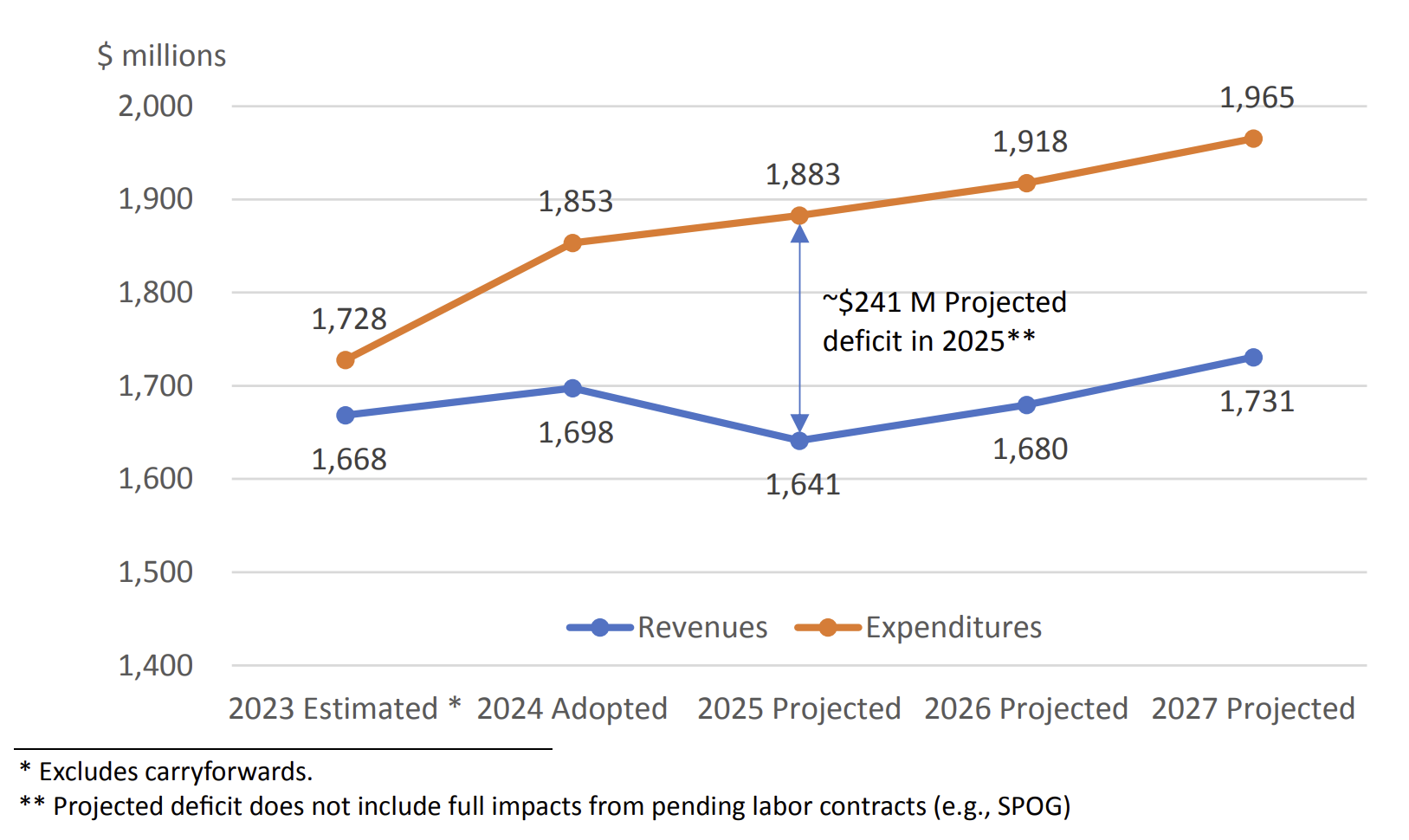
In the next post, we’ll look at the steps City leaders have taken to address the General Fund’s “structural deficit”, including an increase to the B&O tax that would add $80 million in revenue per year.