
Seattleites care about the ability to move across the city safely and easily, proving it at the ballot box time and again. In 2024, voters approved the third Transportation Levy since 2006, providing a dedicated property tax for new projects and ongoing operations. They also have voted recently in favor of a six-year 0.15% sales tax to support transit projects. These funds combine with other revenue sources to support the Seattle Transportation Department’s (SDOT) $553 million annual budget.
What are these investments paying for? And are they paying off?
Are the City’s roads, bridges, sidewalks, and mass transit services in better condition, improving mobility for more people, and preventing accidents?
In the first of a two-part series, this post examines how transportation is funded, where that money is going. Next post will examine how much of a difference those investments are making.
Transportation revenue and spending performance
SDOT is responsible for about $28 billion worth of infrastructure assets, including 3,944 lane-miles of roads, 126 bridges, and 38,565 street trees.
Its largest funding source comes from the Transportation Levy, which represents about a third of the Department’s combined operating and capital budget. Other revenue sources include the General Fund, Real Estate Excise Tax (tax on the sale of property), vehicle license fees, the sales tax for transit, matching state and federal grants, among many other sources.
Analysis of the recently expired Levy to Move Seattle provides a comprehensive view of transportation spending and its priorities. Spanning from 2016-2024, Move Seattle raised $930 million with targeted funding for:
- Safe routes, which includes repainting crosswalks and new bike lanes
- Maintenance and repair, which includes repaved roads and seismic upgrades for bridges
- Congestion relief, which includes major projects at transit corridors
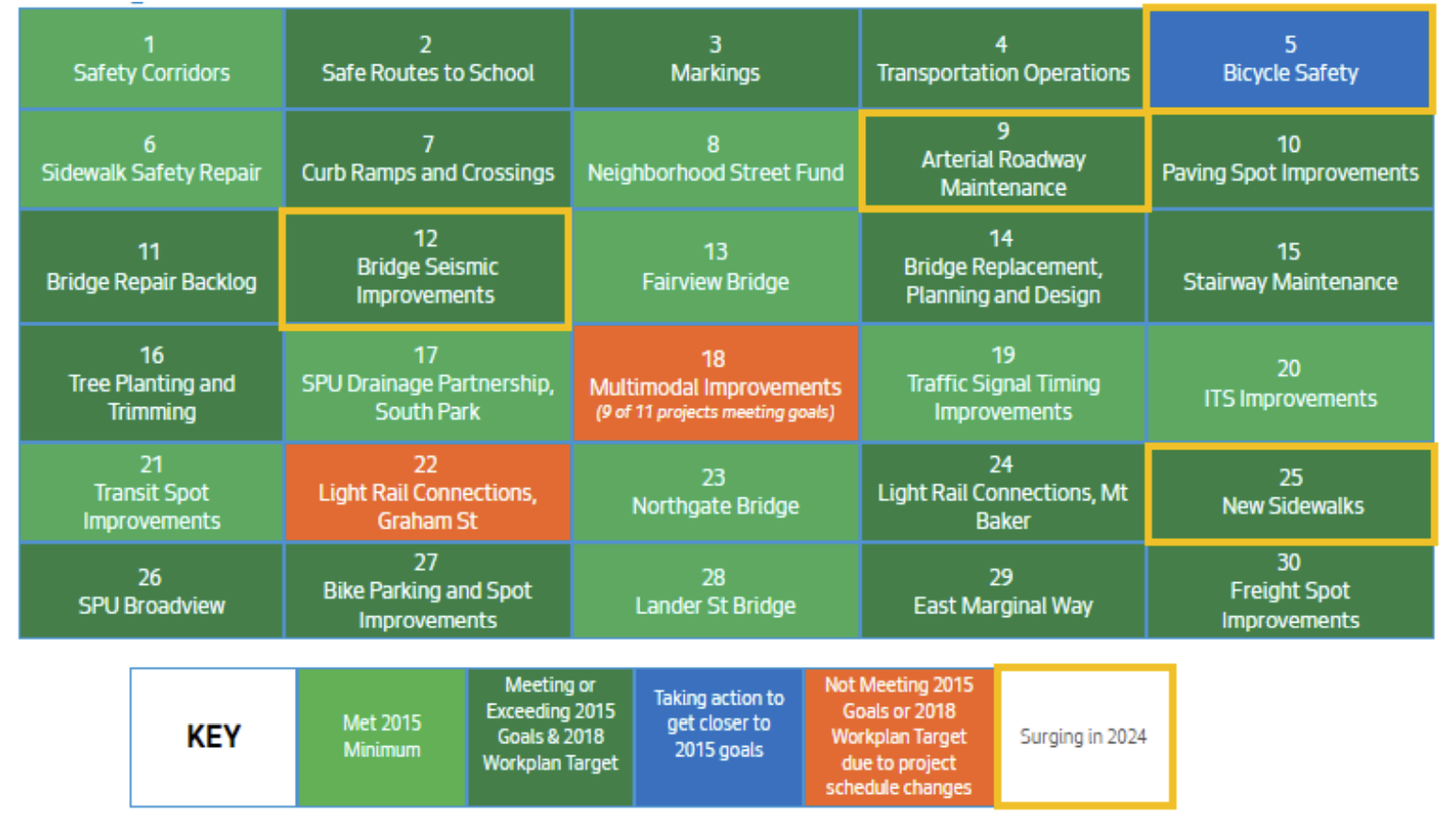
At the end of 2024, SDOT reported to the Levy oversight committee that 27 out of 30 programs were on track to meet goals, boasting improvements at 30 major safety corridors, 227 Safe Routes to Schools projects, and 234 lane-miles of repaved roads.
Source: SDOT
It’s notable that five of those programs were meeting goals revised over the course of the levy, due to higher-than-expected construction costs and reduced federal matching grants.
For example, the Bridge Seismic Program’s original project list received revised cost estimates that were a combined $663 million more than the 2015 estimates. To put that into context, the revised estimates would have drained more than 70 percent of the entire nine-year Move Seattle revenue. To address the gaping imbalance, the Department swapped out five of the largest projects including the Ballard Bridge, Fremont Bridge, and bridges over the Argo railroad, replacing them with smaller projects. The final tally of bridges started or completed during the Move Seattle levy time period is 16, which was the original goal.
In some instances, the Levy program exceeded its original goals. The target for new sidewalks was originally 150 miles. By the end of 2024, the Levy had funded more than 250 miles.
Financial stewardship is another performance measure the city tracks. With $930 million in revenue raised from property owners, SDOT managed to spend $833 million over the life of the Levy. That leaves about 11 percent unspent. The largest areas of under-spending track to the programs that struggled to meet targets. The multi-modal improvements program, for instance, failed to spend $27 million or about a quarter of its total budget. The light rail program at Graham St. was zeroed out, deferring the City’s portion of the Sound Transit project to future years.
With additional funds through federal grants and other sources, the total Levy-related spending is $1.78 billion, which is 12 percent shy of the $2.03 billion projected spend.
In the next post, we’ll look at how these investments are performing.