

We support crime intervention programs that help young people accused of minor offenses. Why? The U.S. misdemeanor system targets low-income communities of color and “entrenches poverty,” according to the Brennan Center.
We support job training opportunities for young adults of color. Why? The average national Black-white unemployment ratio is 2-to-1, a stubbornly consistent figure that is reportedly getting worse under Trump.
We support racial equity justice programs that help organizations actively work against systems of oppression. Why? Pick your favorite data source on discrimination in our financial, housing, hiring, education and justice systems.
We happily pay the taxes that support these types of services. And we feel betrayed when the money fails to flow to the people who need them.
So, I’m sure you’ll join us in feeling outrage at the waste, fraud, and abuse scandal uncovered in a recent Seattle Times’ blockbuster investigation.
The programs described above are among those mentioned in the report, which found King County Department of Community and Human Services (DCHS) overlooked “red flags suggesting contractors were misusing tax dollars.”
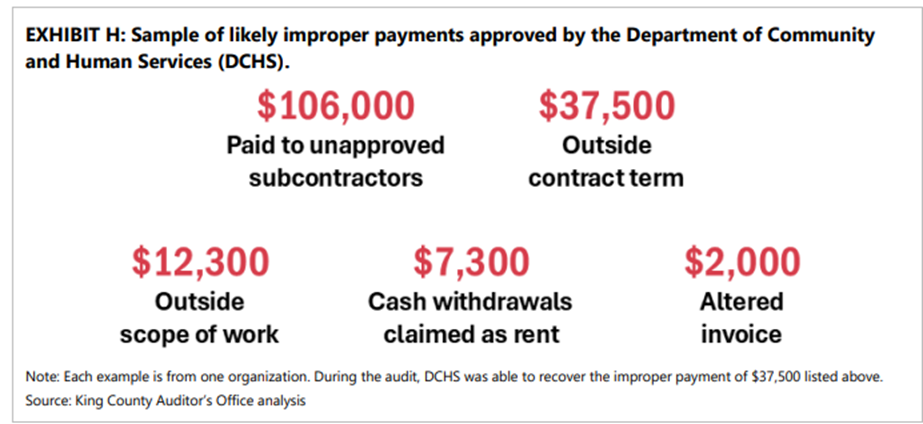
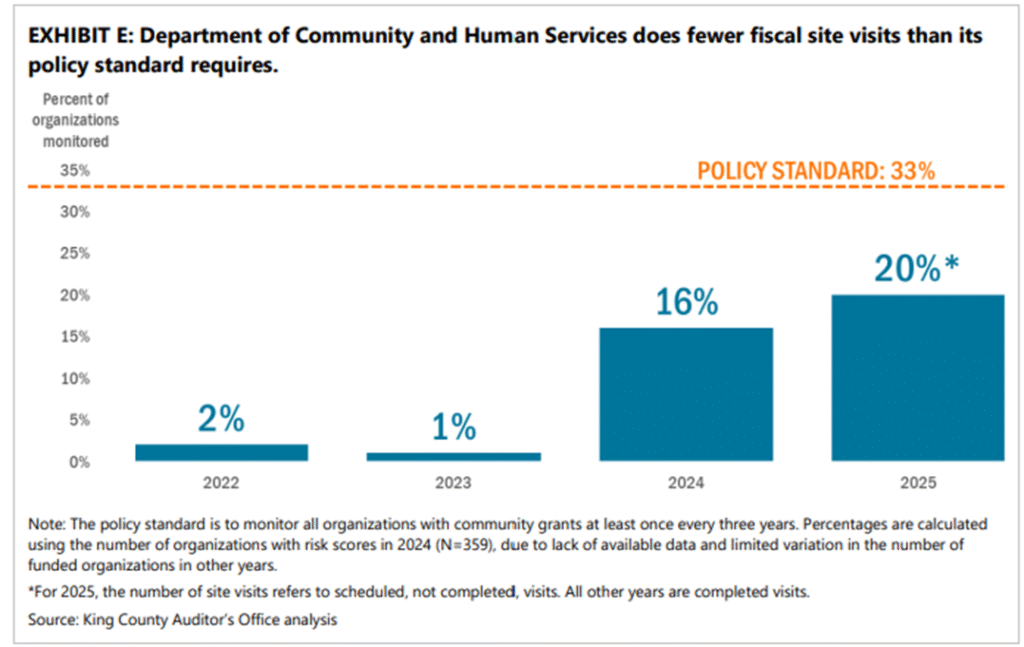
DCHS provides very limited direct services. On its website, it says “for most work, we contract with our trusted network of community-based agencies.” Of 359 contractors awarded DCHS grants in 2024, 48% were considered “high risk,” meaning they lack contracting experience or have few financial resources or policies, according to the county auditor’s report.
The auditor did a deeper dive on 36 of those contractors and 19 were referred for investigation. Do some napkin math on the entire universe of “high-risk” contracts and we’re looking at possibly 89 contractors that scammed the system. And that’s just from 2024.
The number of county contractors jumped from 419 in 2019 to 591 last year—the rise attributed to the pandemic.
In other words, The Seattle Times report may be just the tip of the iceberg.
King County is hardly alone in massive budget growth in recent years. Seattle—and it’s safe to say most jurisdictions across Washington—saw Covid-era relief funds pour in to rapidly support needs in public health and other human services.
The City of Seattle’s Human Services department, for example, also relies on community-based contracts. Its budget rose from $198 million in 2019 to $385 million in 2025, a 94% increase.
It’s worth asking: as funding surged, did Seattle and other local governments build the staffing and oversight systems needed to ensure these programs were administered with integrity?
The frustration goes beyond wasted taxpayer dollars. Mismanaged public funds erode trust in government and hand critics an easy argument against the policies many Seattle and King County residents believe in. The case for public investment is strongest when government proves it can deliver results with integrity.
So the next we come forward with data that says we need new programs for children, seniors, and other vulnerable communities, the answer is an obvious Yes.