
Overview
Seattle’s Housing Levy is a voter-approved property tax that funds affordable housing construction, preservation, and assistance for low-income residents. First adopted in 1981, the levy has been renewed six times and is now a central pillar of the City’s housing strategy.
The most recently completed cycle — the 2016–2023 Housing Levy — authorized $290 million over seven years to finance rental housing, homeownership programs, and homelessness prevention. This analysis examines how that levy performed relative to its original goals, based on the Seattle Office of Housing’s Annual Investment Reports (2020–2023) and the 2016 Housing Levy Administrative & Financial Plan.
A Brief History of the Housing Levy
Since 1981, Seattle voters have approved a local property-tax levy roughly every seven years. Each renewal has expanded in size and scope to respond to rising housing costs and population growth.
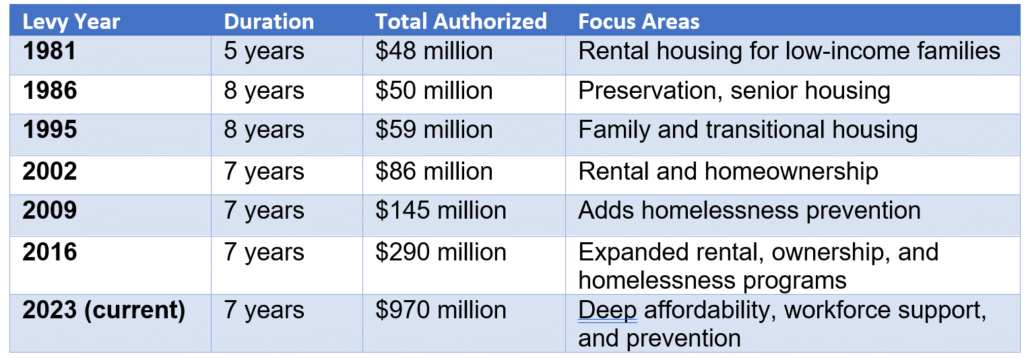
(Sources: Seattle Office of Housing, City Budget Office)
2016 Housing Levy Background
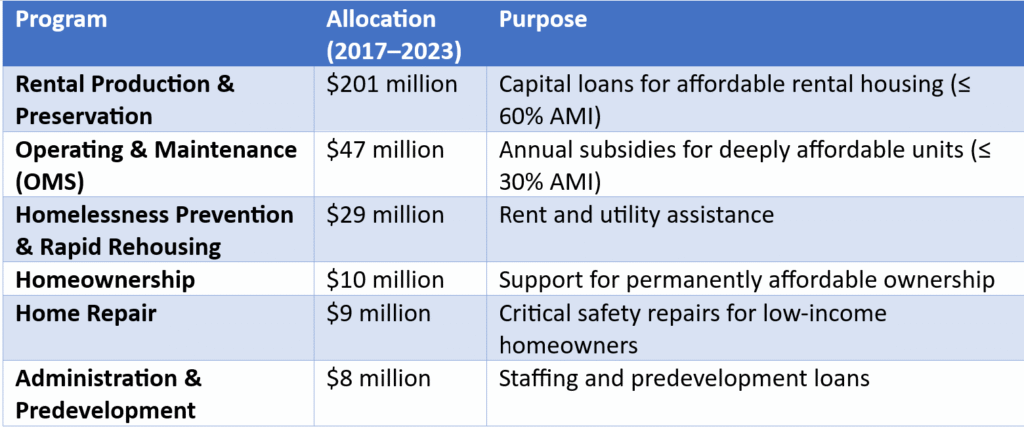
The 2016 levy, approved by 70% of voters, raised property taxes at $0.33 per $1,000 of assessed value — about $122 per year for a median-valued home in 2017. It was designed to raise $290 million over seven years, distributed across six programs:
Expenditures and Leverage
From 2017–2023, the City expended the full $290 million authorization.
- Average annual spending: about $40 million.
- Leverage ratio: every $1 in levy funding attracted roughly $3 from federal, state, and private partners.
- Total public/private investment leveraged: ≈ $1.1 billion.
This leverage is consistent with the City’s prior levy performance.
Goals vs. Outcomes
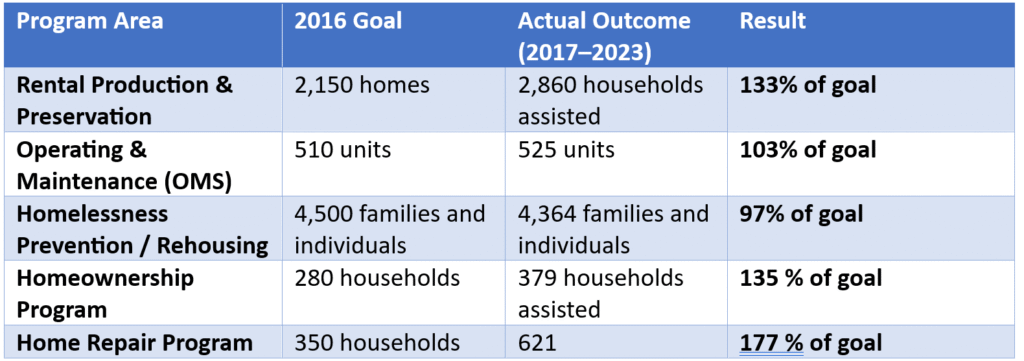
The 2016 levy set numerical targets in its Administrative & Financial Plan.
Measurable Impacts
Rental Housing
Roughly 3,600 affordable rental homes were created or preserved through the levy.
About half serve households earning ≤ 30% of area median income (AMI), including permanent supportive housing for formerly homeless residents.
Average city contribution per unit: $55,000–$65,000, or about 18 % of total project cost.
Homeownership and Repairs
The levy supported 270 permanently affordable for-sale homes and funded ≈ 500 home repairs for low-income homeowners.
Homelessness Prevention
Approximately 4,500 households received short-term rental or utility assistance, meeting the program’s target but not reducing citywide homelessness rates, which continued to rise.
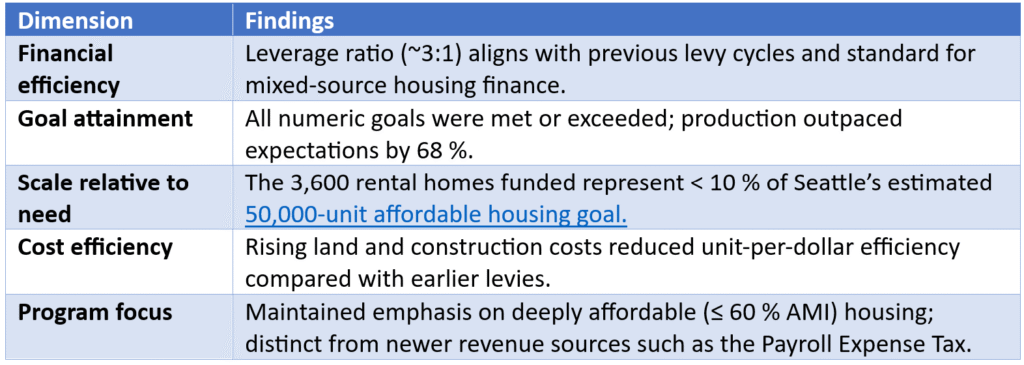
Analytical Assessment
Conclusion
Measured against its own stated objectives, the 2016–2023 Seattle Housing Levy was effective. It met or exceeded all production, subsidy, and prevention goals, leveraged significant external funding, and maintained program integrity across multiple housing types.
However, the levy’s scale — roughly $40 million per year — remains small relative to Seattle’s broader housing affordability gap.In absolute terms, it produced thousands of units; in systemic terms, it mitigated but did not reverse cost pressures driven by land scarcity and population growth.
The evidence suggests that the Housing Levy is a high-performing but limited tool: it delivers on what voters fund, but cannot on its own close the affordability deficit facing the city.
In a future post, we will examine what changed with the 2023–2030 Housing Levy, as well as the City’s comprehensive affordable housing program, of which the Housing Levy is but a piece.